to top

Thesis Topic
This thesis investigates the multiple dimensions of wall design in eighteenth-century China and Italy from a cross-cultural perspective. It does so through the study of wallpaper sets, individual panels, embroidered silk hangings, and preserved historical interiors. Wall design can take multiple visual and material forms. Each chapter discusses one of the possible aesthetic dimensions of wall hangings, thus aiming to give a multifaced vision of how the pictorial wall came to be reimagined in the eighteenth century through different processes of design translation.
The majority of studies on Chinese wallpapers have been concerned with outlining the ‘origins’ of wallpaper production, attempting to reconstruct a linear history of the medium. This project, instead shifts the focus on the multiple methods and media through which the wall was rematerialized and imagined in China and Europe. It refers to the sources as ‘wall hangings’ and, more broadly, ‘wall art’ —limiting the use of the term ‘wallpaper’ to coordinated paper sets of panels. This research project thus expands the scope of analysis by discussing the design interfaces between painted silk sets, embroidered hangings, paper panels, wall canvases.
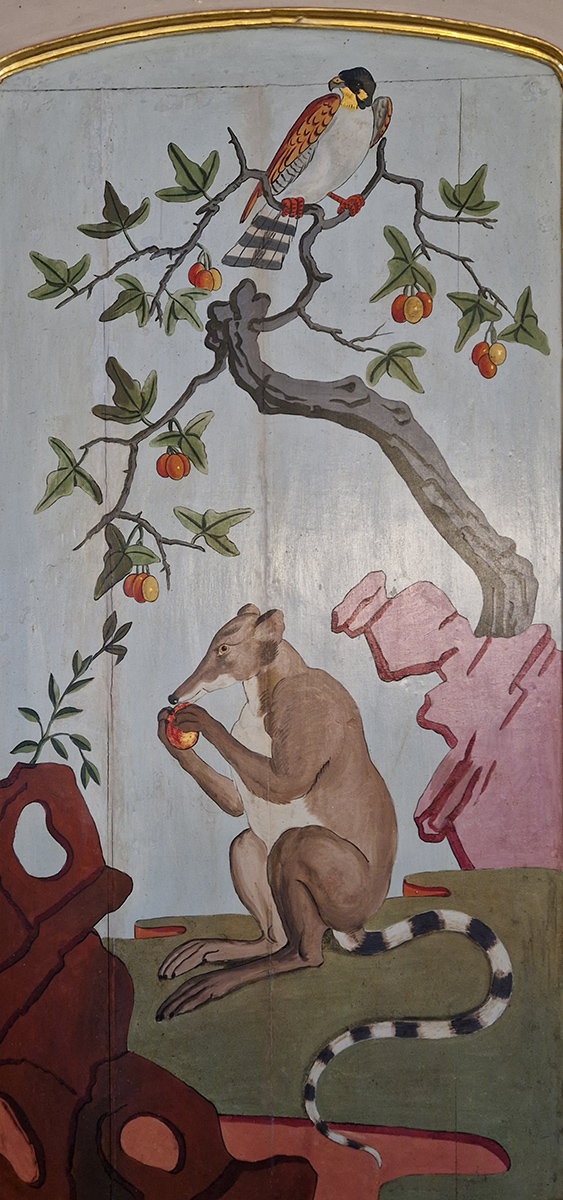
More in detail, the dissertation focuses on Chinese wall hangings and their imitations depicting animals, plants, and objects preserved in present-day Northern Italy. By highlighting the creative agency of workshops, individual artists, and collectors in Guangzhou, Suzhou, Turin, Florence, and Padua, the project explores how multiple actors articulated their own aesthetic language through cross-cultural wall design.
Through the micro-histories discussed in the dissertation’s three case studies, the project highlights how diverse were these encounters and the aesthetics they produced. These aesthetics responded to and amplified those emerging from different sites/media of knowledge production, such as botanical and zoological manuals; artisanal pattern books; encyclopaedias. The dissertation thus draws a tapestry where different ways of thinking and re-thinking wall art across different cultural and political contexts coexisted.